
Hooked on a Feeling
Wars are usually introduced to the public with a vocabulary meant to reassure. Intelligence. Strategy. Alliances. Threat assessments. The heavy furniture of statecraft gets arranged carefully so the decision looks deliberate, inevitable, almost administrative. But sometimes the language begins to wobble. The explanation shifts. Someone clarifies. Someone else contradicts them. Eventually the story holding the whole enterprise together rests on something thinner than policy and heavier than instinct.
A feeling.
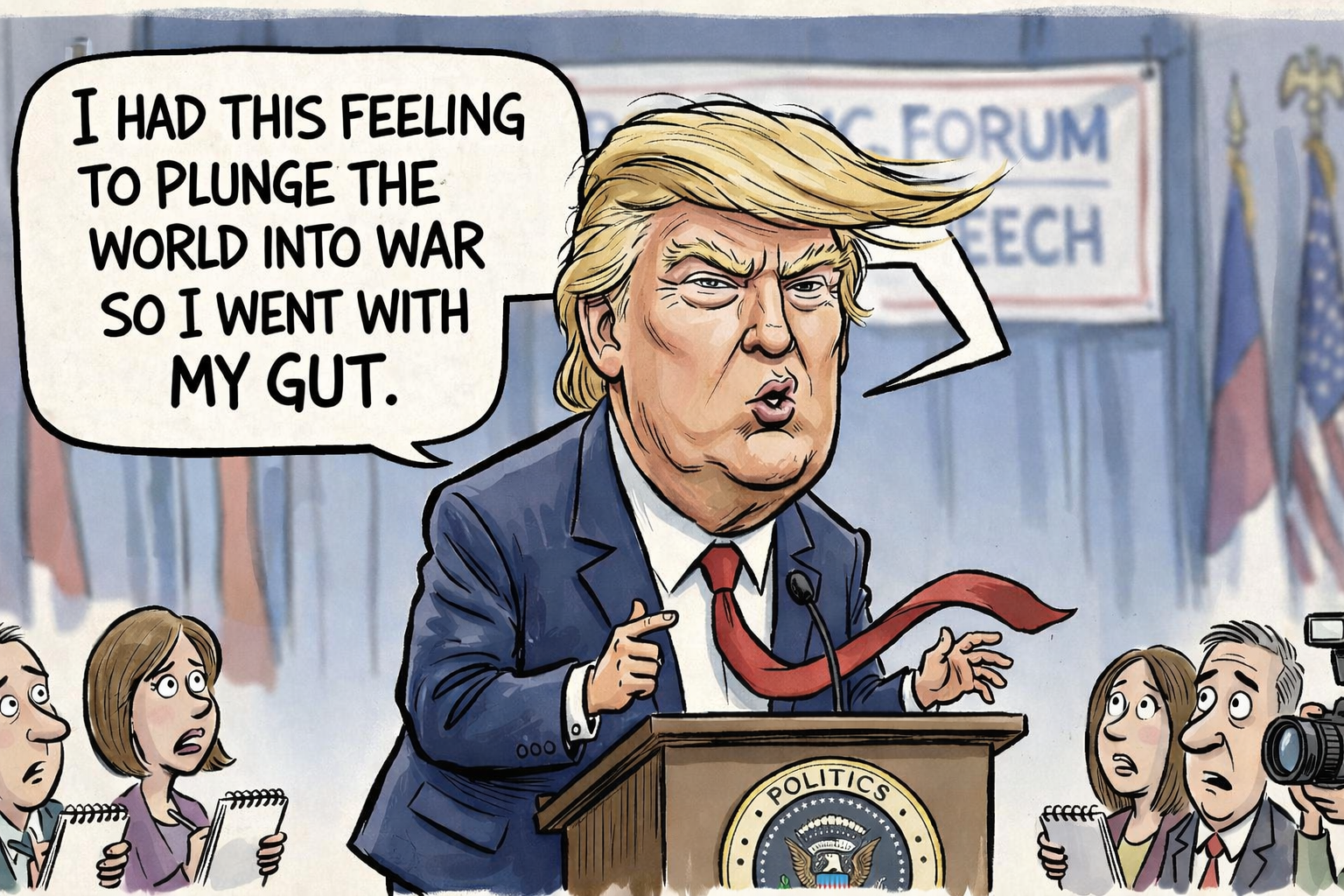
Standing at the White House this week, Donald Trump explained why the United States struck Iran. He did not cite a report or a satellite image. He did not reference a briefing or an assessment. Instead, he explained that he believed Iran was about to attack first. If the United States did not strike, he said, Iran would. “I felt strongly about that.”
The thing about feelings is that they are difficult to cross-examine.
The United States intelligence community had previously assessed that Iran remained at least a year away from developing a nuclear weapon. Yet the president’s explanation now sits at the center of the largest American military action in the region since Iraq: a belief that Iran was about to strike and that the United States simply moved first. It is an extraordinary rationale for war, delivered with the casual certainty of someone explaining a purchase rather than a military campaign.
Of course, feelings were not the administration’s first explanation. The rationale has moved around like a suspect changing alibis. On Monday, Secretary of State Marco Rubio suggested the United States acted because Israel was preparing to strike Iran and Washington feared retaliation against American forces. By Tuesday, the explanation had shifted: Iran itself was preparing to attack, and the United States preempted it.
Same war. Different origin story.
Wars built on shifting explanations inevitably produce practical questions no one seems prepared to answer. When reporters asked Trump who might run Iran now that several of its senior leaders have been killed, the answer was disarmingly blunt. “The people we had in mind are dead,” he said. “Now we have another group. They may be dead also.”
This is not normally how regime change is introduced to the public.
War planning traditionally works backward from the end: who governs afterward, how the country stabilizes, which institutions survive, what replaces the crater. Here the crater appears to have arrived first. The leadership list, apparently, did not survive contact with the bombing.
Meanwhile American diplomats and civilians across the region are scrambling to leave as airspace closes and embassies shutter. When asked why evacuation plans were not already in place, Trump returned to the same explanation. Everything happened very quickly.
Which is another way of saying the feeling arrived before the plan.
There is a strange historical echo here. The story Americans eventually told themselves about the invasion of Iraq was that the war rested on intelligence that turned out to be wrong. The system failed. The data misled us. But this time the emerging narrative is simpler and more unsettling. The intelligence did not fail.
It was bypassed.
The justification for war, delivered from the Oval Office podium, was not a dossier or a threat assessment. It was intuition — a premonition that Iran was about to attack.
History tends to be unkind to wars that begin this way. Not because leaders are incapable of intuition; every president eventually relies on instinct. But instincts are usually followed by a plan. This time the instinct appears to have been the plan.
And now the United States finds itself inside a war whose explanation continues to evolve even as the bombs are still falling. That leaves a quiet question hanging over the entire enterprise. If the reason for the war keeps changing, which one are we supposed to believe?
Or perhaps the more honest question is this: what exactly does a superpower do once it has acted on a feeling?
Sources:
Yahoo News: https://sg.news.yahoo.com/rationale-striking-iran-already-mess-204402076.html